


Nieuw
Muskus & Vijg
Wit
28% parfumolie

What really happens to a perfume bottle when it's empty, and what a refillable fragrance changes.
—
You finish a bottle of perfume and drop it in the glass bin. It feels like the right thing to do.
The uncomfortable truth is that in many cases, that bottle never becomes a new bottle. Not because you did anything wrong, but because of how perfume bottles are built.
How much do you know about your perfume bottle?
Often it doesn't. The pump is crimped onto the glass, with a metal spring and a plastic tube inside, and mixed materials are hard to separate. Point 1 shows why.
Thick glass and a heavy cap usually outweigh the liquid, and that's before the box and cellophane.
Ascent is extrait de parfum, with up to 40% perfume oil. Point 3 shows what that means for plastic.
Look closely at the top of most perfume bottles. The pump isn't screwed on; it's crimped on, pressed permanently onto the glass neck so it can't leak or be removed. Inside it there's a small metal spring and a plastic dip tube.
Recycling works by separating materials. Glass, metal and plastic fused together are hard to separate, and the glass itself is often thick, coloured or coated. Depending on where you live, that can mean the bottle is sorted out and discarded rather than melted down.
And the bottle is only part of it. There's the rigid box, the insert and the cellophane. All of it made for a product you open once.

The real waste isn't one bottle. It's that the whole system is designed to be thrown away and replaced. Every time you finish a fragrance you love, you buy a new bottle, a new pump, a new box and new wrapping to get more of the same liquid.
If you wear perfume every day, that adds up to a cupboard of glass over the years. Most of it heavier than the perfume it held.
There's a simpler way to do it.
Ascent was built around one idea: the container should last, and only the perfume should be replaced. The case is machined from aerospace-grade aluminium, made to last a lifetime and to be refilled endlessly. Here's what that changes every time you run out:
Up to
98%
less plastic per equivalent use
The case is the part you see. Investing in what actually touches your skin, instead of disposable packaging, is the founding idea of Ascent, and it runs through everything else too:
Every Ascent scent is vegan and free of microplastics.
Developed with master perfumers in Grasse, the home of French perfumery.
By social enterprises that create meaningful work for people who face barriers to employment.
Refills travel by regular post, from warehouses in the Netherlands and France.
The boxes we ship in are made from 100% recycled paper.
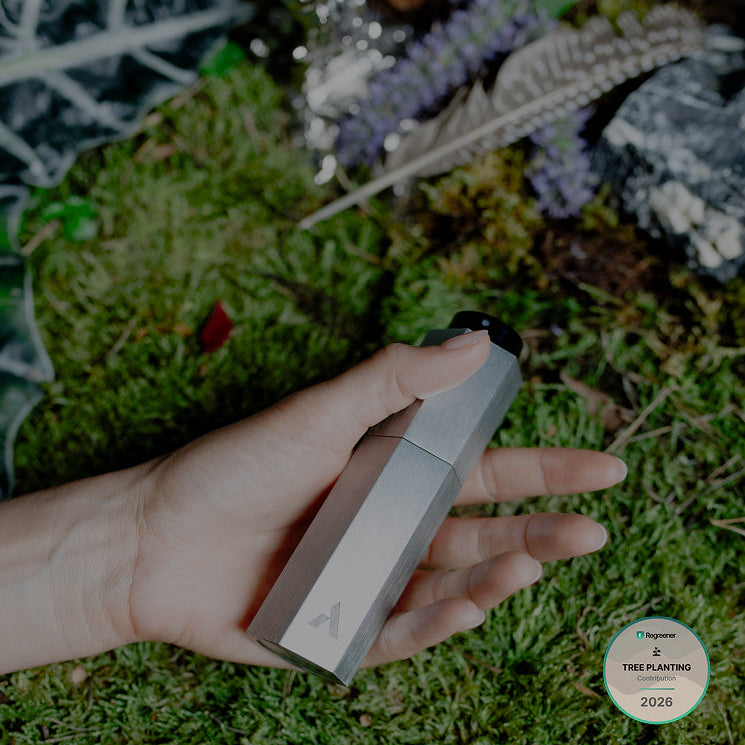
Making, filling and shipping fragrance causes emissions. Ours too. So we work in that order:
What we cut at the source
What we fund on top
These contributions don't make our products carbon neutral, and we won't claim they do.
Often, yes. Not here. The refill is the most concentrated form of fragrance there is, in a case that feels better in the hand than the glass it replaces. And to be straight with you: a refill still comes with some packaging, just a fraction of a new bottle, box and pump.

Afhalen is op dit moment niet beschikbaar
Each Ascent fragrance is gender-free and built around a distinctive scent profile, from bright citrus to deep woods and warm spices.
Wit
28% parfumolie

Bruin
38% parfumolie

Blauw
38% parfumolie

Groen
25% parfumolie

Oranje
35% parfumolie

Paars
30% parfumolie

Rood
25% parfumolie

Teal
37% parfumolie
Compared with buying a new 100 ml bottle each time.
| Feature | Ascent | New bottle |
|---|---|---|
Refillable, no bottle to bin |
Ja | Nee |
Up to 98% less plastic |
Ja | Nee |
Fits through your letterbox |
Ja | Nee |
Vegan & microplastic-free |
Ja | Nee |
Assembled in Rotterdam |
Ja | Nee |
Try at home, €25 back |
Ja | Nee |
See for yourself.